

Writing Style Guides for Editors and Authors: Why They Matter and How to Get Started
A writing style guide is a living reference document that captures your organization’s editorial decisions. It ensures everyone producing content for your organization is operating from the same foundation. It covers everything from grammar and punctuation to voice and tone.
For mission-driven organizations, a writing style guide does something beyond ensuring consistency. The decisions it encodes shape how your internal and external audiences come together to develop common understanding, recognize shared values, and ultimately how you frame, approach, and solve complex problems. If your organization publishes reports to effect change at a systems level, a writing style guide can power and accelerate your influence.
What is a Style Guide
Wherever content is created, the conditions for a writing style guide exist. They can be produced at any level: at the organizational level, the special initiative or program level, or the individual contributor level. For mission-driven organizations, a writing style guide is a centralized mechanism to facilitate knowledge sharing and management, as well as organizational alignment and coherence that drive social change.
A writing style guide creates benefits that compound over time. They reduce the back-and-forth in editorial reviews, the inconsistencies that accumulate within and between reports, and the cognitive load that develops when common language is left undefined. They ensure a seamless user experience as someone moves between reports and programs, as well as print and digital environments. A cohesive experience for your audience means greater brand recognition and trust, which, in turn, amplifies your influence.
IMPORTANT: A writing style guide should provide an enabling framework. Diversity of voice, opinion, and perspective matters. The goal is not conformity for the sake of uniformity. The goal is to establish a baseline that reduces friction and dissonance. If there is a clear rationale for departing from the writing style guide, they should be allowed as long as the decision is deliberate and consistent throughout the product.
What follows is a simple introduction to what a writing style guide is, why it matters, and how to get started. But before we dive in, we’ll start with a bigger idea: that the editorial decisions documented in a style guide aren’t just about good housekeeping and professional publishing.
Design for Social Innovation
There’s a new-ish field called Design for Social Innovation that treats designed artifacts (products, systems, services, and communications) as the infrastructure through which new social practices emerge and spread. A writing style guide, in that frame, is not just a reference document. It’s a tool that produces a shared way of seeing a problem and distributes it across an organization, a network, or a movement. A writing style guide is one of the places where shared mental models and common language are captured, tested, and encoded. You move from contributing to the conversation to shaping it. For mission-driven organizations working at the intersection of research, policy, and science, a writing style guide becomes a force accelerator.
Take for example, GLAAD’s Media Reference Guide. GLAAD, a nonprofit advocacy organization, has been setting the standard for how journalists report on LGBTQ people and issues for more than two decades. When they released the 10th Media Reference Guide, they shared that the guide has shaped the editorial standards of the Associated Press, Reuters, the New York Times, and the Los Angeles Times. When organizations document their editorial standards, they can be shared to inform and shift industry-wide practice. That’s what a well-built writing guide can do and why they matter, beyond the practical application within your organization.
Getting started
The easiest way to get started is with a list of decisions your team has already made. Add to it as decisions arise. A style guide that’s a living document you actually use is more valuable than a comprehensive one that no one opens.
You can also identify an established style guide as your foundation and layer your organization’s specific guidance on top of it. Choose one, name it explicitly, and build from there. Here is a list of the most common guides:
- APA Style (American Psychological Association) is the standard for the social sciences, including psychology, education, and public health research.
- AP Style (Associated Press Stylebook) is the standard for journalism, public relations, and digital communications.
- Chicago Manual of Style is the reference for book publishing, history, and the arts.
- MLA Style (Modern Language Association) is used in the humanities, particularly in literature and cultural studies.
What Makes a Writing Guide Uniquely Yours
Once you’ve captured decisions your team has made and chosen an established style guide as your foundation, these are the elements that give your guide its organizational identity:
- Who you are. Your organization’s full legal name with correct spelling and punctuation, along with any approved shorthand, abbreviations, or acronyms. Your mission, vision, values, and tagline. Boilerplate content that appears repeatedly can also live here, so everyone pulls from the same source.
- Voice and tone. Your voice is what you say. What type of content do you publish? Is there anything that you do not publish? Defining which subjects you do cover is just as important as what you don’t. Your tone is how you say it. How formal or conversational is your organization’s writing? Where do you sit on the spectrum between academic and conversational? Include examples of what that looks like in practice.
- Words you use and don’t use. Every field has terminology that means different things to different audiences. Your style guide is where you record the terms your organization has chosen, the ones you avoid, and why.
- Recurring decisions. Capitalization rules for your specific program names and sector terms. How you handle numbers, dates, and percentages. Do captions end with periods, even if they are not complete sentences? If your organization works internationally, identify when to use American English or British English, and when to provide translations.
Keeping Your Style Guide Current and Relevant
Creating a style guide is easy. Keeping it relevant is where things can fall apart.
Here are two likely scenarios you may encounter. The first is the shelf document: a document that was carefully produced, distributed, and then forgotten. The second is the living document with no owner: everyone edits, and things accumulate with no order or plan. To avoid these scenarios, identify which functions are necessary and who on your team is responsible. Depending on the size of your organization, this may fall under the purview of an individual, a team, or a committee.
Roles and functions to consider:
- Stewarding – who is responsible for owning the document? where does the buck stop?
- Updating – who is responsible for documenting things that are decided in a meeting, project, or comments section of a document?
- Reviewing and approving – who is responsible for reviewing additions? Who is responsible for approving? What gets incorporated into the next version, and what gets cut? Is this based on the consensus of a group or a single individual?
- Sharing – who is responsible for delivering updates and new versions to contributors, and what mechanisms are used to support adoption?
Establish a plan and cadence. For example:
- Create a page at the end of your document titled “New Additions.” Depending on the size of your organization, maybe everyone has edit access, or maybe you identify a committee, or a single person to update this section as new decisions are made.
- Quarterly, review and share additions with people directly affected, so they can test it and iterate as needed. This process can produce feedback loops to test changes before they become the new standard.
- Annually, incorporate all approved additions and release a new version to internal and external contributors. Communicate changes and additions carefully, so that they don’t get buried, lost, or forgotten.
- Reintroduce the style guide when a new project kicks off. Be sure to store it somewhere it can be easily found and referenced.
The primary goal of this post is to provide a simple introduction to writing style guides, how to get started, and how to support their adoption. But I also hope this post got you thinking about how writing guides can ultimately deepen your organization’s impact.
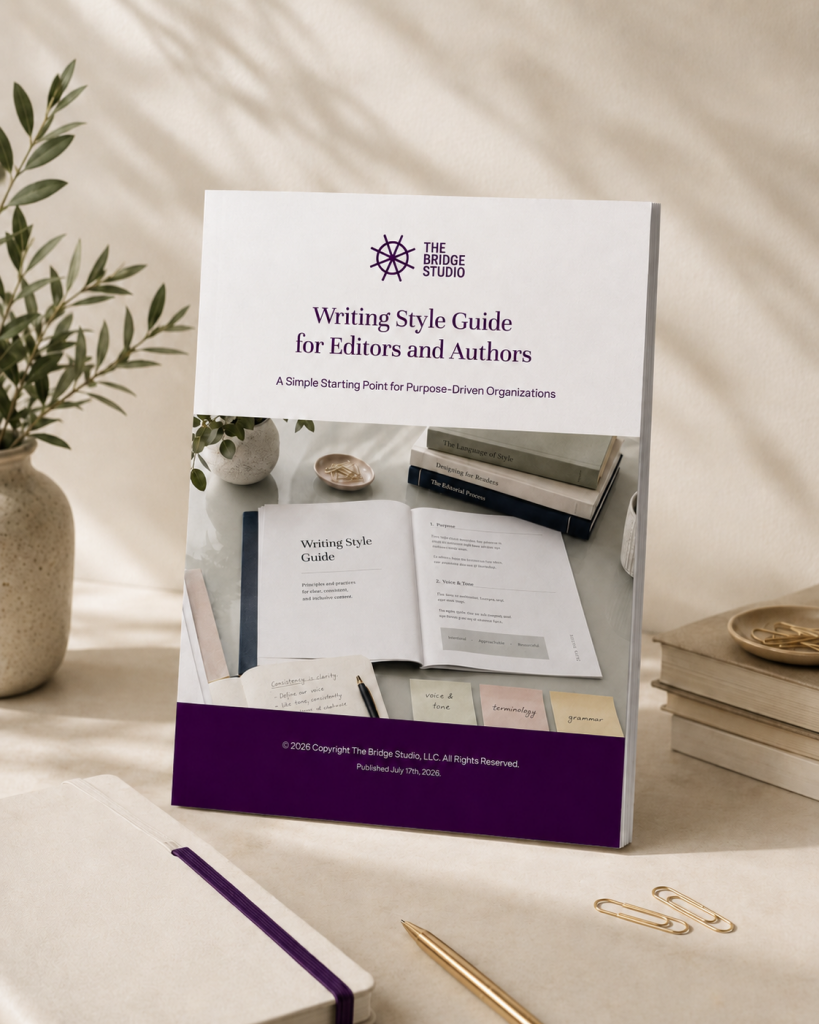
Free Download: Writing Style Guide Template
If you’re ready to begin building your own writing style guide, we have created a free template to help you get started.
In this resource, you will find guidance on how to do everything covered in this article, as well as guidance on how to use your writing style guide to produce an AI voice skill.
If you found this post helpful, have questions, or want to get started on your next report, schedule a free consultation.